Seeing Like and Beyond James C. Scott (1936-2024)
Speaker: Olivia Angé – Université libre de Bruxelles
Dates: 25 & 26 June 2026
Venue: Campus Condorcet - France
Link: Link to PDF
Scott’s work stands out both for the breadth of his empirical contribution and for the richness and heuristic power of his conceptual input. It has helped to renew perspectives on enduring questions in the social sciences and anarchist domains—such as the nature of the State, the definition of the political, and forms of domination and resistance to authority. Read as much in anthropology, sociology, history, philosophy, and even archaeology, James Scott has been a source of inspiration for each of these disciplines, while also drawing critical debate. He thus embodies a “crossroads author” whose work enables genuine interdisciplinary dialogue. His ideas have also resonated beyond the academic sphere, particularly among activist communities organized around the critique of the state. This conference aims to revisit Scott’s legacy by confronting his concepts with empirical fieldwork, a methodological stance he himself encouraged. It seeks to evaluate the analytical potential of engaging dialogue with his work and to reconsider the scope and applicability of his theoretical tools. In order to avoid engaging in commemorative or hagiographic homage, the event will adopt a resolutely critical stance, in tune with the epistemological approaches of anarchism that Scott helped to develop. Indeed, some of his works have sparked controversies which would be interesting to trace and, above all, to debate.
Abstract of the presentation
Escape Tubers and the Politics of Agricultural Articulations in an Andean Ecology of Potato Cultivation
In the Cuzco highlands, growers depend on potatoes for healthy sustenance, just as potatoes depend on their growers to flourish. This daily mutual entailment contrasts sharply with human-tuber articulations at the margins of maize plots in lower lands, where wilder potato relatives of the araq family thrive. Although they are exempt from the everyday work of cultivation, those who eat araq are nonetheless attentive to them. Their unique tuberous way of inhabiting the fields invites an examination of what humans and tubers « are rendered capable of" through their encounters (Despret 2008). Inspired by James Scott, I propose the notion of “escape tubers” to attend to the politics of agricultural articulations involving plants that are capable of thriving on their own. This perspective diverts domestication narratives away from human quest for control over plants. Rather, it reveals a complex ecology of agricultural practices in which human obligations toward undisciplined plants are increasingly undermined by the surrounding expansion of hybrids varieties.
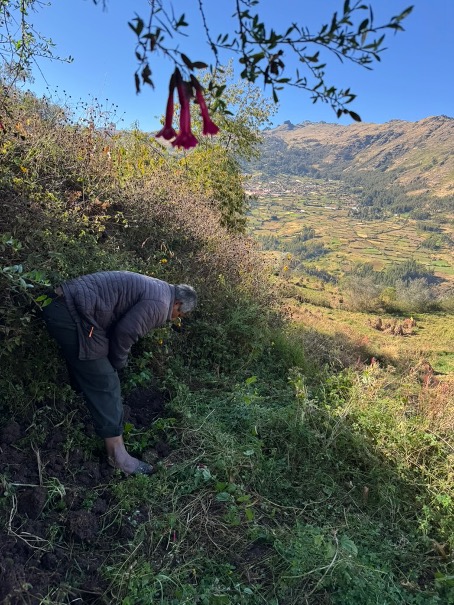
Silent digging in search for araq encounter at the edge of a maize plot.