Rau - Decolonising Plant Knowledge: Voices from Subverted Plant Worlds
Speaker: Olivia Angé - Université libre de Bruxelles
Dates: 11 March 2026
Venue: Cambridge University - United Kingdom
Link: https://www.crassh.cam.ac.uk/events/47794/
RAU is a polysemic concept shared among Indigenous Western Amazonians to designate plants that confer power, knowledge, personhood and shamanic agency. RAU plants are transformative, serving as multifunctional medicines, poisons, and entheogens, while also providing food and building materials, whole or in parts. This interdisciplinary seminar series explores aspects of RAU as a crucible of creative epistemic frictions between botanical narratives and colonised plant worlds. Numerous scholars have examined the political frameworks and categories that have historically shaped botanical narratives and representations in empires. Still, the 'colonisation of knowledge', in its dialogical aspects, was never complete. Colonised people have maintained and even developed the polyvalence of their plants and plant knowledge in ways that further destabilise and enrich the categories imposed on them in the name of science. In a decolonising perspective, we are attentive to voices from plant worlds which colonisation has subverted in the past and, in new forms, continues to subvert. With a primary focus on Latin America yet open to comparison, we aim to address these voices in thematic, interdisciplinary seminars that gather researchers in person and online.
Escape Tubers and the Politics of Agricultural Articulations in an Andean Ecology of Potato Domestication
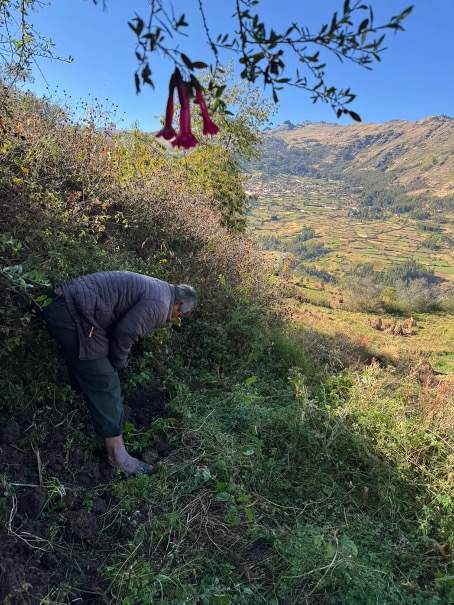
In the domestication center of the Cuzco highlands, growers depend on potatoes for healthy sustenance, just as potatoes depend on their growers to flourish. This daily mutual entailment contrasts sharply with human-tuber relations at the margins of maize plots in lower lands, where wilder potato relatives of the araq family thrive. Although they are exempt from the everyday work of cultivation, those who eat araq nonetheless care for them. During the lean period, these tubers offer delicious and nourishing food, imbued with medicinal powers stemming from their ancestral genealogy. This unique tuberous strength invites an examination of what humans are “rendered capable of” through their encounters with araq (Despret 2008). Inspired by James Scott, I propose the notion of “escape tubers” to attend to the politics of agricultural articulations involving plants that are capable of thriving on their own. This perspective diverts domestication narratives away from human quest for control over plants. Rather, it reveals a complex ecology of domestication practices in which human obligations toward undisciplined plants are increasingly undermined by the surrounding expansion of hybrids varieties.